
Mobility, Strength, Golfswing: Achieve an Elite Swing | External Focus Golf

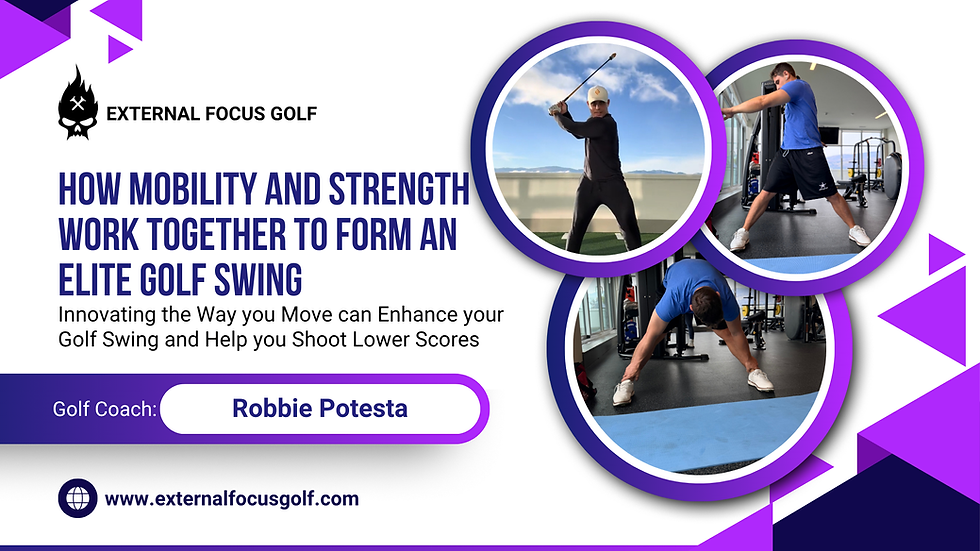
Improving your mobility and strength can create an environment where your body is able to swing at an elite level.
Mobility and Strength Can Systematically Improve Your Golf Swing
Golf might look easy, but it is actually a very technical sport. To play well, you need coordination, control, and power. The two most important physical qualities for golfers are mobility and strength. More mobility means moving your joints freely and efficiently, and strength means having the power to swing the club effectively. Together, they help you swing farther, play more consistently, and reduce your risk of injury.
Mobility, Strength, The Golf Swing
Mobility is your ability to move joints through a full range of motion with control. In golf, mobility in the hips, thoracic spine (upper and mid-back), shoulders, and pelvis is especially important. If your joints are stiff, you might compensate with other parts of your body, which can reduce your swing power and increase the risk of injury.
Research shows that golfers with better hip and trunk rotation have higher club head speeds (Evans & Tuttle, 2015). Mobility exercises, like thoracic rotations and hip stretches, are proven to improve movement and performance (Skopal, 2024). By improving your mobility, you can achieve better positions in your swing and move more efficiently on the course.
Mobility alone is not enough. You also need strength, especially strength that can be used quickly, to generate power in your swing. Studies show that golfers who follow strength and functional training programs increase their club head speed and overall performance (Lamberth, 2013; Smith, 2014).
In simple terms, mobility lets you get into the right positions, and strength allows you to apply force through those positions. Without strength, even the most flexible golfer cannot maximize power.
How Mobility and Strength Work Together
Mobility, strength, and the golf swing are most effective when they are combined. Mobility gives you the range of motion, while strength lets you control that motion and generate power. Limited mobility can force the lower back to compensate, increasing injury risk. By improving both, you can swing efficiently, hit farther, and reduce stress on your body (Titleist Performance Institute, 2025).
Preventing Injuries
Golf is a repetitive sport that puts stress on the spine, hips, and shoulders. Lack of mobility and strength increases the risk of injuries, like low back pain or shoulder problems. Exercise programs that improve mobility, strength, and core control can help prevent injuries while enhancing performance (Thomas, 2023).
Improving your physical fitness means you can play longer, avoid pain, and enjoy the game more.
Simple Tips for Golfers
Here are some practical ways to improve your mobility and strength:
Check your mobility: Test your hips, shoulders, and thoracic spine for stiffness.
Do mobility exercises: Try hip rotations, thoracic spine rotations, and stretches that improve rotation.
Add strength training: Focus on your glutes, hips, core, and upper body. Squats, lunges, planks, and medicine-ball rotations work well.
Work on speed and power: Use explosive exercises like medicine-ball throws or band rotations to swing faster.
Practice golf-specific movements: Apply your mobility and strength in drills that mimic your swing.
Stay consistent: Regular training improves performance and reduces injury risk over time.
Conclusion
To improve your golf game, focus on building mobility and strength. Mobility helps you move efficiently, strength helps you swing with power, and together they reduce the risk of injury. This approach is backed by science and is key for golfers of all levels who want to play better and stay healthy.
Talk soon,
Robbie Potesta
External Focus Golf


Comments